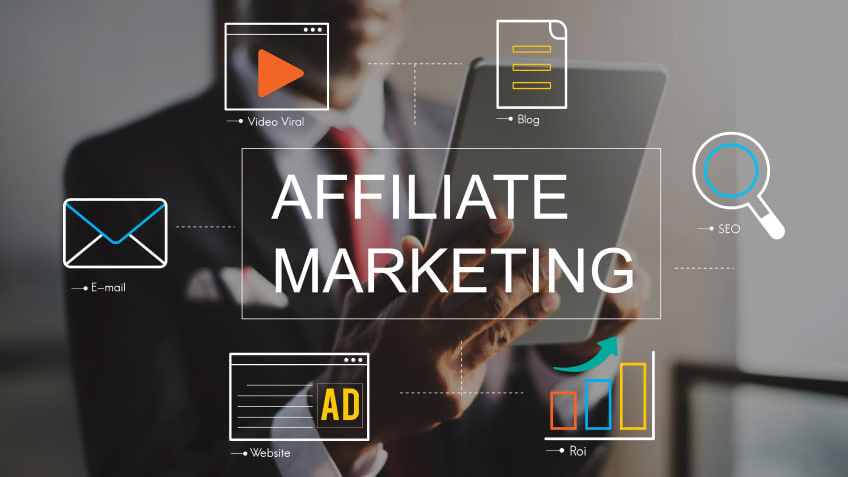
The High-Ticket Pivot: Mastering Affiliate Marketing in 2026
Let’s have a “real talk” moment. If you’re still trying to build an affiliate empire by promoting $20 gadgets on Amazon, you’re essentially working for digital pocket change.
As we navigate 2026, the affiliate landscape has split into two worlds: the “churn and burn” low-ticket crowd fighting for pennies, and the High-Ticket Architects who are building sustainable, six-figure businesses on the back of software, finance, and specialized services.
The game hasn’t gotten harder; it’s just gotten more professional. Here is how you build an affiliate business that doesn’t just “get clicks” but actually builds wealth.
1. Why High-Ticket? (The Math of Sanity)
In the old days, volume was king. Today, margin is king.
Consider this: To make $5,000 a month with a standard consumer affiliate program (offering 5% commission), you need to move $100,000 worth of product. That’s a massive amount of traffic.
In the high-ticket world—think enterprise software (SaaS), specialized hosting, or premium financial tools—a single conversion can net you $200, $500, or even a recurring monthly commission for the life of the customer. You don’t need a million visitors; you need 50 of the right people.
2. The 2026 “Power Verticals.”
To maximize your ROI, you must play where the money is “sticky.” These are the niches dominating the 2026 landscape:
-
SaaS & AI Tools: Companies are desperate for efficiency. Tools that automate workflows or integrate AI into business processes often offer 30% recurring commissions. That is “sleep well at night” money.
-
FinTech & Trading: From high-yield savings platforms to advanced trading bots, the finance niche remains the highest-paying sector. However, the barrier to entry is Trust (E-E-A-T). You cannot fake expertise here.
-
High-Performance Hosting: As the web becomes more complex (and AI-heavy), standard $5/month hosting doesn’t cut it. Enterprise-grade cloud hosting and managed WP services pay massive bounties because their customer lifetime value (LTV) is huge.
-
Betting & iGaming: A high-regulation, high-reward niche. If you can navigate the compliance, the “rev-share” models in this space are among the most lucrative in the world.
3. The Content Trinity: Blogs, YouTube, and Email
Gone are the days of the “thin” review site. To rank in 2026, you need a multi-channel approach that surrounds the user.
The Blog (The Foundation of Intent)
Your blog is where you capture “Comparison” and “Alternative To” traffic. When someone searches for “Best AI CRM for Real Estate 2026,” they are ready to buy. Your job is to provide the most transparent, data-backed comparison on the internet.
-
SEO Tip: Focus on “Search Task Accomplishment.” Don’t just list features; show how the software solves a specific pain point.
YouTube (The Trust Accelerator)
People buy from people they trust. A video showing a “Behind the Scenes” look at a software or a real-money test of a trading platform carries more weight than 5,000 words of text.
-
The Strategy: Use YouTube to show the process. Use the description box to drive users to your “Bridge Page” or directly to the offer.
Email (The Profit Engine)
If you aren’t building a list, you’re just renting your business from Google and YouTube. In 2026, the “First-Party Data” is your only real asset. Use a lead magnet (a checklist, a free automation script, or a mini-course) to get people off the platforms and into your ecosystem.
4. The “Anti-AI” Content Strategy
Ironically, in a world full of AI-generated articles, the most effective SEO strategy is aggressive humanity.
Google’s 2026 algorithms are hyper-focused on “Experience.” They want to see:
-
Original Imagery: No more stock photos. Take your own screenshots. Record your own screen.
-
Personal Case Studies: “I used this hosting for 6 months, and here is my actual uptime report.”
-
The “Why it Sucks” Section: No product is perfect. By telling your readers what’s wrong with a product, you gain the trust necessary to sell them on what’s right.
5. Compliance is Your Moat
With the FTC and global regulators tightening the screws on “hidden” affiliate links, being transparent is actually a competitive advantage. Clear, bold disclosures shouldn’t be hidden in the footer. Place them front and center. It signals to your audience that you are a professional, not a shill.
The Bottom Line
High-ticket affiliate marketing in 2026 is a marathon, not a sprint. The “easy” niches are crowded, but the “expert” niches are wide open.
Stop looking for the next “hack” and start looking for a high-value problem that a high-ticket product solves. Become the bridge between that problem and the solution, and the commissions will take care of themselves.
Are you ready to switch to high-ticket?
The middle ground is disappearing. You either compete on price (and lose) or you compete on authority. Choose authority.